AI Energy Consumption: 7 Powerful Facts About AI’s Growing Power Demand
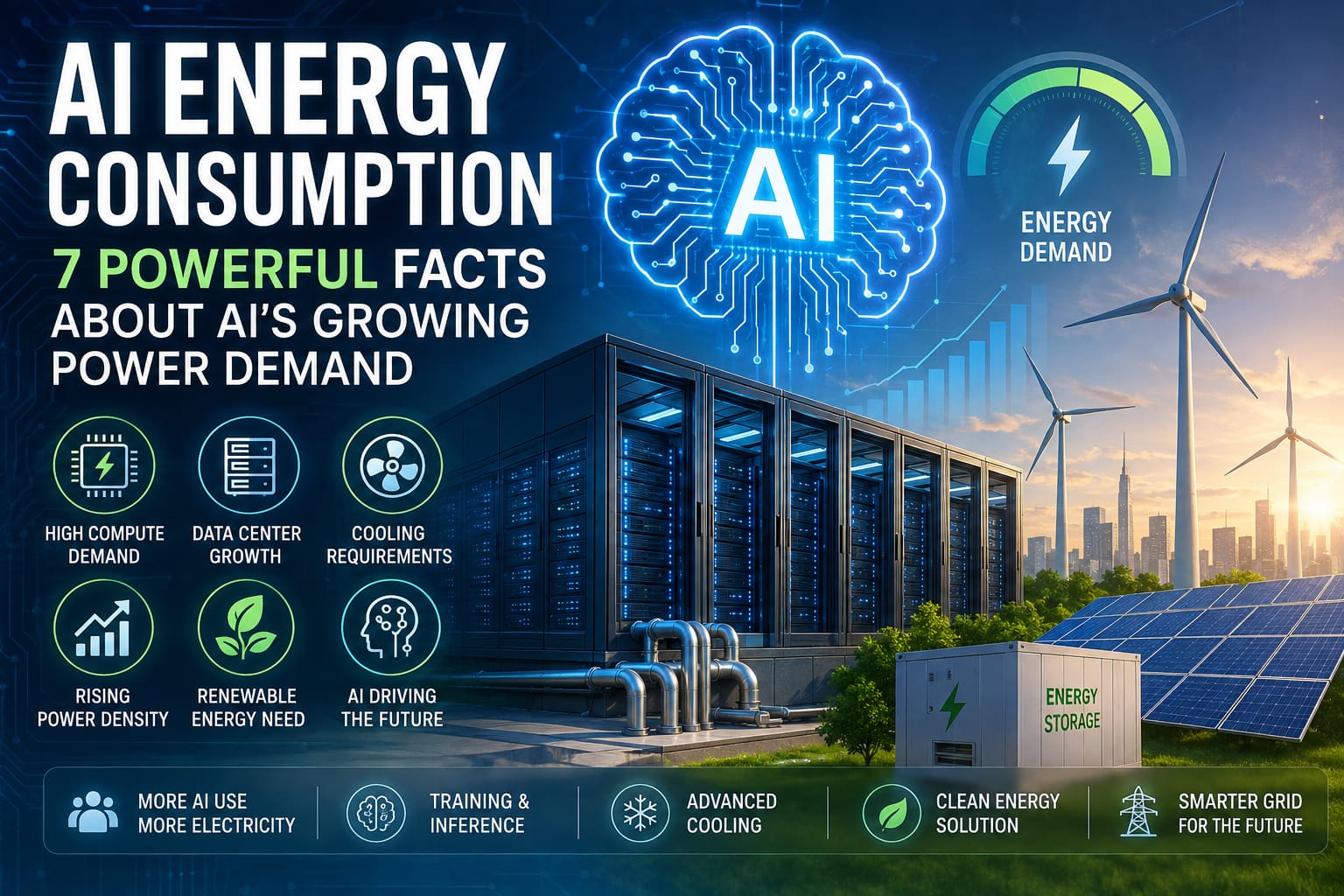
AI Energy Consumption is becoming one of the most important energy topics as artificial intelligence expands across businesses, search, healthcare, finance, entertainment, and automation. Behind every AI model are powerful processors, data centers, cooling systems, networking equipment, and electricity infrastructure. As AI becomes more advanced and widely used, its growing power demand is creating both challenges and opportunities for the global energy sector.
Table of Contents
- What Is AI Energy Consumption?
- Why AI Energy Consumption Is Growing
- AI Data Centers and Electricity Demand
- AI Training and Inference
- Cooling and AI Energy Consumption
- Renewable Energy for AI
- The Future of AI Energy Consumption
- Frequently Asked Questions
- Conclusion


What Is AI Energy Consumption?
AI Energy Consumption refers to the electricity required to train, operate, and maintain artificial intelligence systems. AI software depends on physical computing infrastructure such as GPUs, CPUs, servers, storage equipment, and networking hardware.
Large AI models can require enormous computing resources during training. After training is complete, electricity is still needed whenever users interact with the model. This process is called inference.
Energy is also required to cool the hardware and operate the supporting infrastructure inside data centers. Therefore, the total energy footprint of AI goes beyond the electricity used directly by processors.
Why AI Energy Consumption Is Growing
One of the biggest reasons AI Energy Consumption is increasing is the rapid adoption of generative AI.
AI is now being used for writing, coding, image creation, video generation, research, customer service, search, data analysis, and business automation. Each new application can create additional computing demand.
The International Energy Agency estimates that global data-center electricity consumption was about 415 TWh in 2024 and could reach approximately 950 TWh by 2030 in its central outlook.
More AI Use Means More Electricity
The number of AI users is also important. A single request may require a relatively small amount of electricity, but millions or billions of requests can create substantial total demand.
More sophisticated applications can require even greater computing resources. Reasoning models, AI agents, image generation, and video generation can be significantly more computationally intensive than simple text-based tasks.
AI Data Centers and Electricity Demand
Data centers are at the heart of modern AI Energy Consumption.
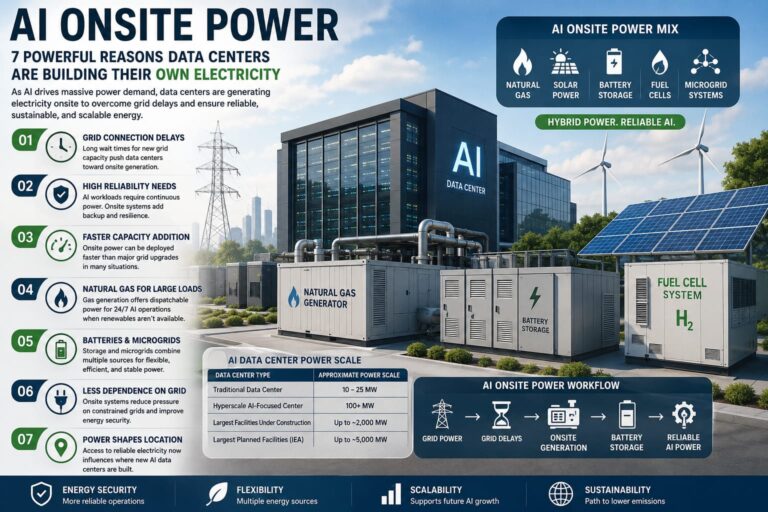
Large AI facilities can contain thousands of high-performance processors operating continuously. These facilities need reliable electricity supplies as well as strong transmission and distribution infrastructure.
| Year | Global Data Center Electricity Demand |
|---|---|
| 2024 | ~415 TWh |
| 2025 | ~485 TWh |
| 2030 | ~950 TWh |
| 2035 | Potentially above 1,200 TWh |
These figures represent overall data-center electricity consumption, not AI alone. However, AI is becoming an increasingly important driver of data-center growth.
Rising AI Power Density
AI processors are becoming more powerful, allowing more computing performance to fit into smaller physical spaces. But higher computing density also means higher electricity use and greater heat production.
This makes efficient power distribution and advanced cooling increasingly important for future AI facilities.
AI Training and Inference
AI Energy Consumption happens primarily during model training and inference.
Training involves processing massive datasets and adjusting a model’s parameters. This can require large clusters of specialized processors running for extended periods.
Inference occurs when a trained AI model processes a request and produces an output.
Why Inference Is Becoming Important
As AI becomes integrated into everyday software, inference could represent an increasingly important source of electricity demand.
AI-powered search, office tools, coding assistants, customer-service systems, autonomous agents, image tools, and other applications can generate huge numbers of inference operations.
The more frequently people use AI, the greater the total computing requirement becomes.
Cooling and AI Energy Consumption
High-performance AI processors generate significant amounts of heat. Data centers must remove this heat to prevent hardware from overheating.
Cooling therefore represents an important part of AI Energy Consumption.
Traditional air cooling is still used in many facilities, but high-density AI environments are encouraging more advanced approaches, including liquid cooling.
Efficient Cooling Can Reduce Power Demand
Better airflow management, liquid cooling, efficient equipment layouts, and improved data-center designs can reduce the electricity needed for thermal management.
This shows why AI efficiency is not only about processors. The entire data-center environment must become more efficient as computing power increases.
Renewable Energy for AI
The growth of AI Energy Consumption is also increasing interest in renewable electricity.
Solar, wind, hydropower, batteries, and nuclear energy could all help meet the growing electricity needs of AI data centers.
Solar Energy and AI
Solar power can provide large amounts of electricity for data centers, particularly in regions with strong solar resources.
However, solar generation changes throughout the day. Batteries and grid connections can help balance electricity supply when solar output falls.
Wind and Nuclear Energy
Wind power can provide another source of low-carbon electricity where suitable resources exist.
Nuclear energy is also receiving attention because AI data centers require reliable electricity around the clock. Nuclear plants can provide continuous generation without relying directly on daily weather conditions.
AI Energy Consumption Growth
The trend demonstrates why AI Energy Consumption is becoming important for electricity planners. Data centers are expected to require substantially more electricity as AI and other digital workloads expand.
The Future of AI Energy Consumption
The future of AI Energy Consumption will depend on a balance between increasing AI demand and improving technological efficiency.
More efficient processors can reduce electricity consumption per task. Better algorithms can reduce unnecessary computation, while advanced cooling can lower the energy required by data centers.
At the same time, increasingly sophisticated AI applications could increase total demand.
AI Could Help Improve the Energy System
AI may eventually help solve some of the energy challenges it creates.
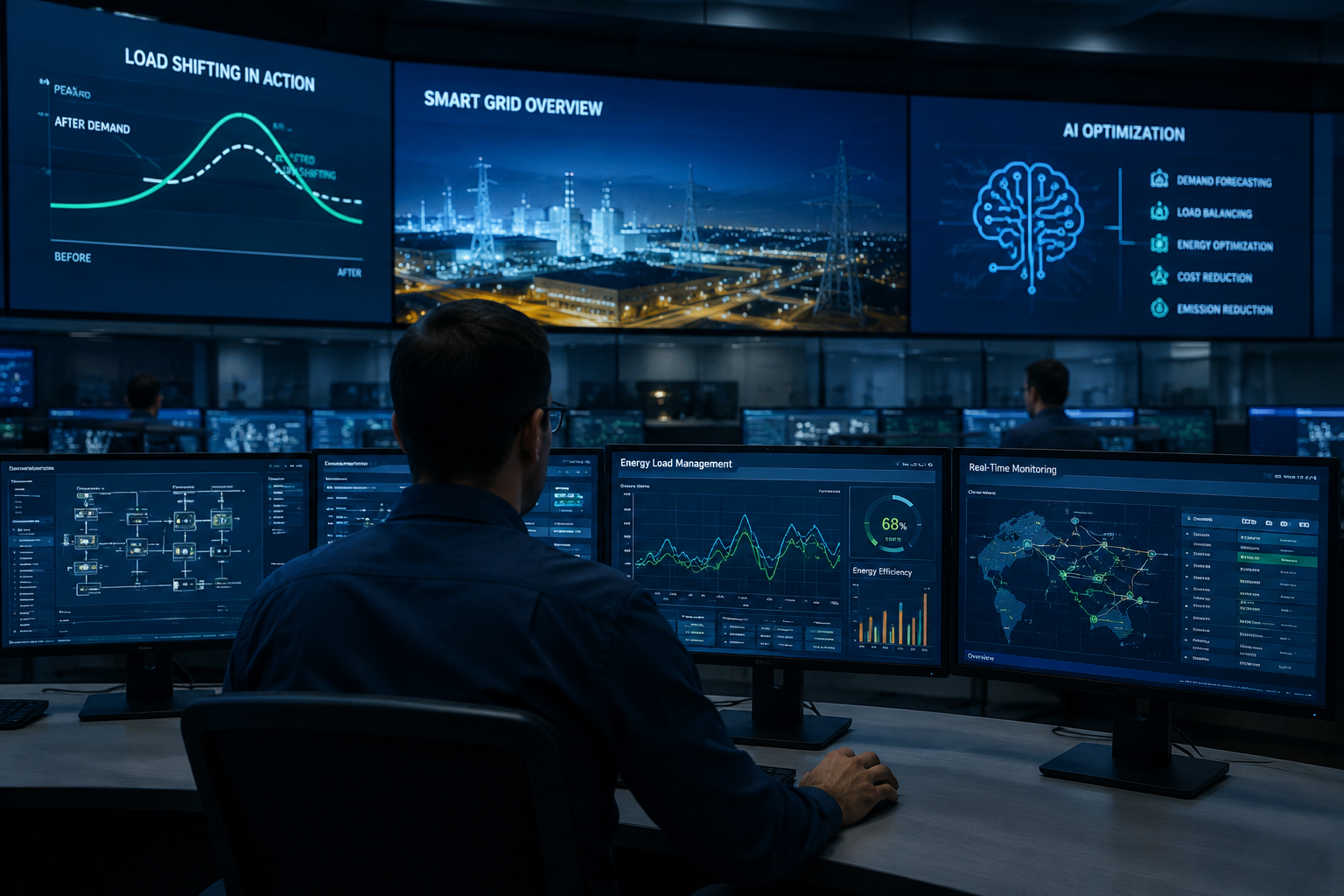
Energy companies can use AI for electricity-demand forecasting, renewable-energy prediction, grid optimization, equipment monitoring, and predictive maintenance.
Data-center operators can also use AI to optimize cooling systems and manage computing workloads.
Internal Link Opportunities
This article can naturally connect with related topics on your website, including AI Data Center Energy, AI Energy Storage, AI Power Grid, AI Solar Panels, AI Energy Forecasting, and AI Nuclear Energy.
Add your existing related articles as internal links around these phrases to help readers discover more energy and AI content.
Frequently Asked Questions
What is AI Energy Consumption?
AI Energy Consumption is the electricity required to train, operate, and maintain artificial intelligence systems, including computing hardware, data centers, cooling, and supporting infrastructure.
Why is AI Energy Consumption increasing?
It is increasing because AI adoption is expanding, models are becoming more advanced, and applications such as generative AI, reasoning, image generation, and AI agents require substantial computing resources.
How much electricity do AI data centers use?
Electricity consumption varies by facility. Large AI-focused data centers can require enormous amounts of electricity because they operate many high-performance processors continuously.
Can renewable energy power AI data centers?
Yes. Solar, wind, hydropower, and other low-carbon energy sources can supply electricity to AI data centers. Battery storage can help manage variable renewable generation.
Does AI consume electricity after training?
Yes. AI models require electricity during inference whenever they process requests or perform automated tasks.
Can AI become more energy efficient?
Yes. More efficient chips, better algorithms, optimized software, advanced cooling, and smarter data-center management can reduce energy consumption per task.
Will AI increase electricity demand?
AI is expected to contribute to rising electricity demand, particularly through expanding data centers. The overall impact will depend on AI adoption, efficiency improvements, and the development of new power infrastructure.
Conclusion
AI Energy Consumption is becoming a major part of the future relationship between technology and energy. AI requires powerful computing hardware, large data centers, cooling systems, and reliable electricity.
As AI adoption continues, electricity demand from data centers is expected to rise substantially. The challenge will be meeting this demand while maintaining affordability, reliability, and environmental sustainability.
More efficient processors, advanced cooling, renewable energy, batteries, nuclear power, and smarter electricity grids can all help support the next generation of AI.
The future of artificial intelligence will therefore depend not only on creating smarter models but also on building smarter and more energy-efficient infrastructure behind them.