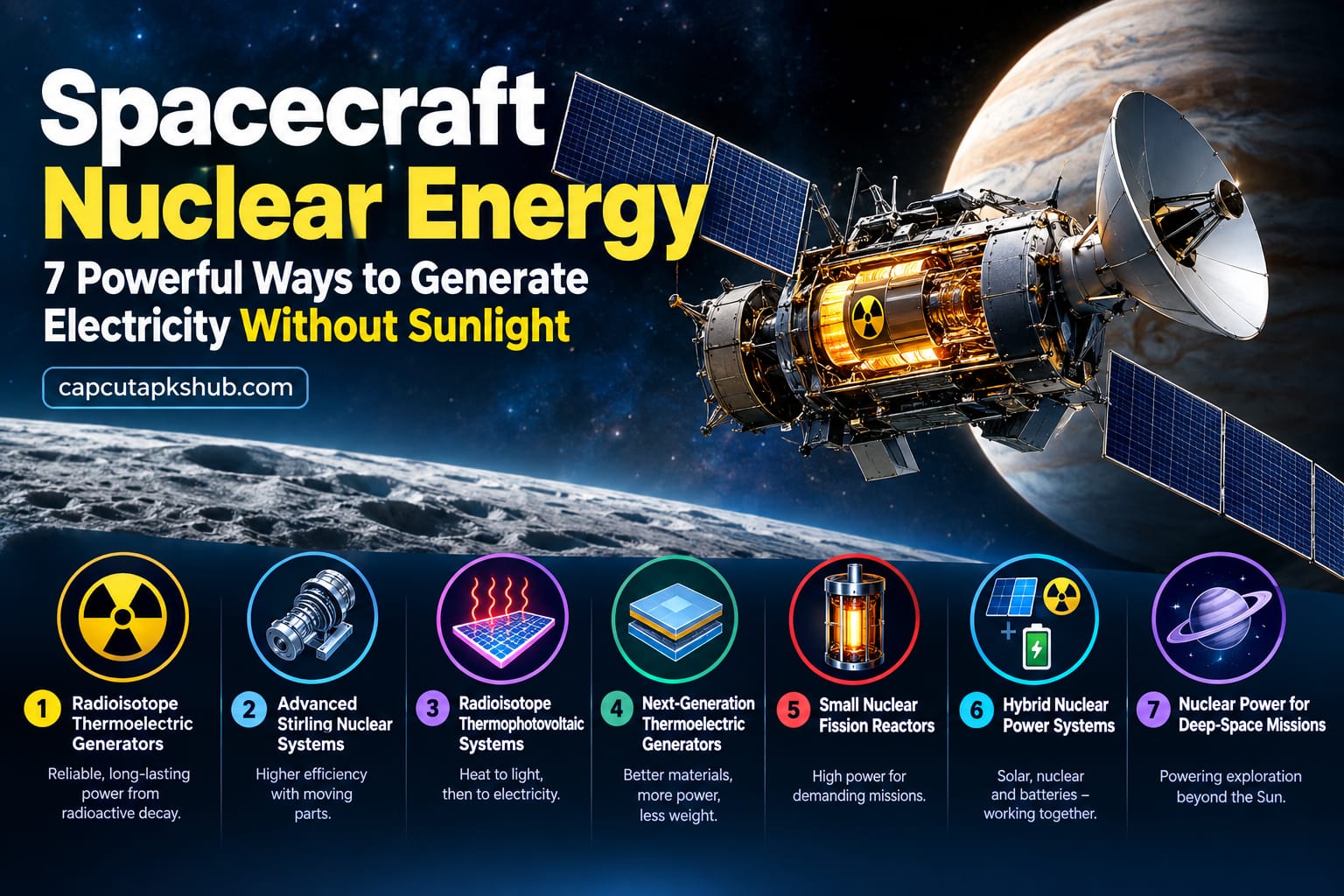
Spacecraft Nuclear Energy: 7 Powerful Ways to Generate Electricity Without Sunlight
Spacecraft cannot always depend on sunlight. When a mission travels far from the Sun, enters a permanently shadowed region, or operates where solar panels become impractical, another source of electricity is needed. This is where Spacecraft Nuclear Energy becomes especially important.
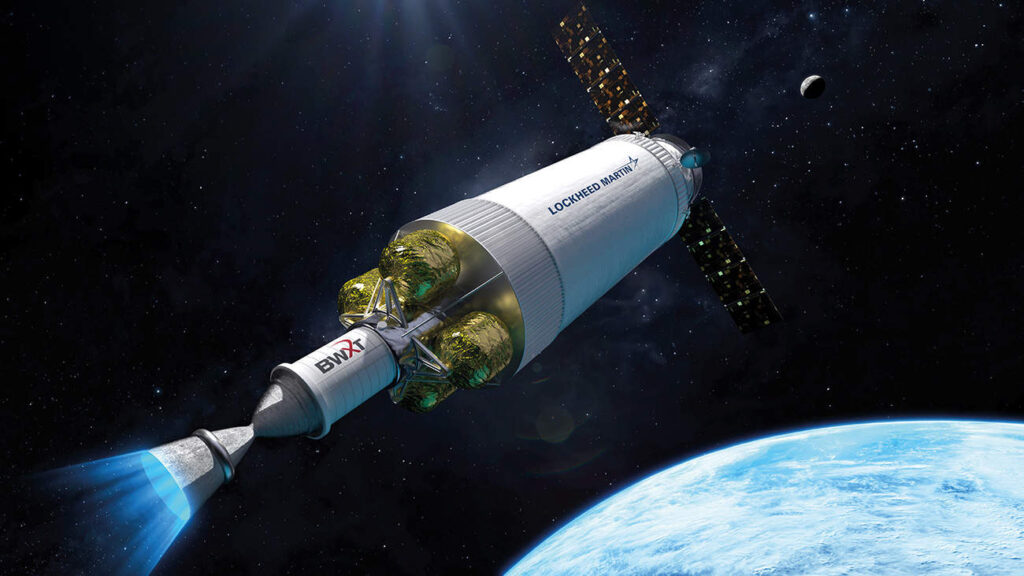
Nuclear power has already supported some of humanity’s most distant space missions. NASA’s radioisotope power systems have operated spacecraft for decades, including the Voyager missions. These systems use heat produced by the natural decay of radioactive material to generate electricity.
The future could go much further. Engineers are studying more efficient ways to convert nuclear heat into electricity and are also developing nuclear reactor concepts for future missions. These technologies could eventually support spacecraft traveling to the outer solar system, long-duration robotic missions, lunar bases, and potentially human exploration.
Table of Contents
- What Is Spacecraft Nuclear Energy?
- Radioisotope Thermoelectric Generators
- Advanced Stirling Nuclear Systems
- Radioisotope Thermophotovoltaic Systems
- Next-Generation Thermoelectric Generators
- Small Nuclear Fission Reactors
- Hybrid Nuclear Power Systems
- Nuclear Power for Deep-Space Missions
- Why Nuclear Power Could Transform Space Exploration
- FAQ
- Conclusion
1. What Is Spacecraft Nuclear Energy?
Spacecraft Nuclear Energy refers to systems that use nuclear processes to provide power for spacecraft and space-based equipment.
There are two broad approaches. The first uses the natural radioactive decay of an isotope to produce heat. The second uses nuclear fission inside a reactor to produce much larger amounts of thermal energy.
Radioisotope power systems are already flight-proven. NASA explains that these systems can provide electricity and heat for decades without relying on sunlight. They are particularly useful in cold, dark, dusty, or distant environments where solar power is difficult to use.
This makes Spacecraft Nuclear Energy especially valuable for missions where reliability matters more than having access to large amounts of solar radiation.
A nuclear power system can continue producing energy during long periods of darkness. It can also avoid the need for enormous solar arrays in locations where sunlight is weak.
2. Radioisotope Thermoelectric Generators
One of the most important forms of Spacecraft Nuclear Energy is the Radioisotope Thermoelectric Generator, commonly called an RTG.
Spacecraft Nuclear Energy An RTG does not work like a conventional nuclear reactor. Instead, it uses the natural decay of plutonium-238 to produce heat. Thermocouples then convert the temperature difference into electricity through the thermoelectric effect.
The design has an important advantage: there are no moving mechanical parts.
NASA’s Multi-Mission RTG has been used on missions including Curiosity and Perseverance. NASA says an MMRTG is designed to provide about 110 watts of electrical power at the beginning of a mission, while also producing useful heat that can help keep equipment warm.
Future versions could become more efficient.
That means the same basic nuclear heat source could potentially produce more useful electricity, allowing spacecraft to operate more instruments, communication equipment, sensors, and computers.
3. Advanced Stirling Nuclear Systems
A future form of Spacecraft Nuclear Energy could use Stirling engines to convert radioisotope heat into electricity.
A Stirling converter works differently from the solid-state thermoelectric systems used in traditional RTGs. It uses temperature differences and mechanical movement inside a sealed system to produce electrical power.
NASA has identified Stirling converter technology as one area being investigated to improve radioisotope power systems.
The attraction is efficiency.
Traditional thermoelectric conversion is reliable but relatively limited in efficiency. Advanced dynamic systems could potentially extract more electricity from the same amount of available heat.
For future missions, that could be extremely valuable.
A spacecraft traveling billions of kilometers from Earth cannot easily be repaired or refueled. Increasing the efficiency of its onboard power system could therefore provide more scientific capability without dramatically increasing the size of the energy source.
4. Radioisotope Thermophotovoltaic Systems
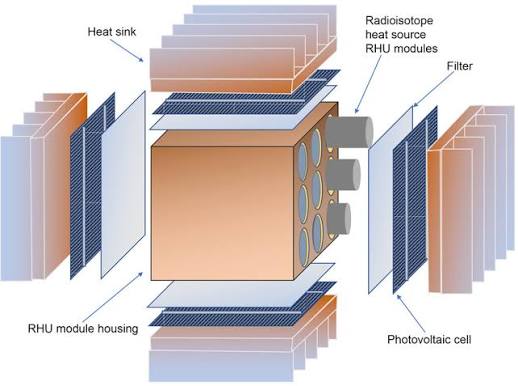
Another futuristic direction for Spacecraft Nuclear Energy involves converting nuclear heat into light and then converting that light into electricity.
This approach is known as radioisotope thermophotovoltaic, or RTPV, technology.
Instead of sending heat directly through conventional thermoelectric materials, the system can use a hot emitter that produces thermal radiation. Photovoltaic materials can then convert selected wavelengths of that radiation into electrical energy.
NASA has investigated advanced radioisotope power technologies and more efficient conversion methods for future missions.
The interesting part is that this could open another path toward improving the efficiency of nuclear batteries.
Imagine a spacecraft operating in deep space with no useful sunlight available. Its nuclear fuel continuously produces heat. Instead of wasting much of that heat, a future conversion system could potentially turn a greater portion of it into electricity.
Such technology remains a developing area rather than a standard spacecraft power source, but it demonstrates how future nuclear batteries could become more capable.
5. Next-Generation Thermoelectric Generators
The future of Spacecraft Nuclear Energy could also depend on better materials.
An RTG’s thermoelectric components determine how effectively heat can be converted into electrical power. Scientists have therefore studied advanced thermoelectric materials that could improve performance.
NASA has investigated materials and technologies intended to improve the efficiency and lifetime of radioisotope power systems.
Better materials could make future generators smaller, lighter, or more productive.
This matters because every kilogram launched into space has a cost.
If a future spacecraft could generate the same amount of electricity from a smaller nuclear power system, engineers could potentially use the saved mass for scientific instruments, communication systems, fuel, shielding, or other equipment.
The improvement might appear small on Earth, but in space exploration even modest efficiency gains can become important.
6. Small Nuclear Fission Reactors
Another major possibility for Spacecraft Nuclear Energy is the use of compact fission reactors.
Unlike an RTG, a fission reactor generates energy through a controlled nuclear chain reaction. This approach could potentially provide much higher power levels than a small radioisotope generator.
NASA is exploring nuclear technologies for space applications, including nuclear electric and nuclear thermal propulsion. The agency describes nuclear electric systems as one potential technology for future space transportation and exploration.
A compact reactor could potentially support missions requiring more electricity than traditional radioisotope systems can provide.
For example, future robotic spacecraft might need high-power radar, advanced communication systems, powerful scientific instruments, or electric propulsion.
A reactor could also become useful for future lunar or Martian infrastructure.
However, these systems are more complex than RTGs. They require reactor design, thermal management, shielding, control systems, and careful mission planning.
7. Hybrid Nuclear Power Systems
Future Spacecraft Nuclear Energy systems may not rely on one technology alone.
A hybrid spacecraft could potentially combine different energy sources.
For example, solar panels could provide electricity when sunlight is strong, while a radioisotope system could continue supplying essential power during darkness.
A larger spacecraft could potentially combine solar arrays, batteries, and nuclear power depending on where it is operating.
This approach could provide greater flexibility.
Near the Sun, solar energy could handle a large portion of the electrical demand. Farther away, nuclear systems could become increasingly important.
The spacecraft could therefore adapt its energy strategy as it travels through different environments.
Such a system would be particularly interesting for long missions that pass through multiple regions of the solar system.
8. Nuclear Power for Deep-Space Missions
The greatest potential of Spacecraft Nuclear Energy may appear when spacecraft travel far beyond Earth.
Sunlight becomes weaker as distance from the Sun increases. NASA notes that Saturn receives only about one percent of the sunlight available at Earth. This makes solar power increasingly challenging for missions operating in the outer solar system.
Nuclear power avoids this particular limitation.
The Voyager spacecraft demonstrate the long-term potential. NASA reports that Voyager’s radioisotope power systems have supported operations for more than 47 years.
Future missions could use improved nuclear systems to investigate distant planets, moons, asteroids, and comets.
Europa, Titan, Uranus, Neptune, and other distant targets could benefit from power systems that do not depend heavily on sunlight. NASA specifically identifies future missions to several of these destinations as potential applications for radioisotope power.
This could make nuclear energy one of the key technologies for exploring the darkest regions of the solar system.
9. Why Nuclear Power Could Transform Space Exploration
The biggest advantage of Spacecraft Nuclear Energy is independence from sunlight.
A spacecraft powered by an appropriate nuclear system can continue producing electricity when solar panels are less useful.
It can also operate through long periods of darkness.
Another advantage is longevity. Radioisotope systems have demonstrated the ability to function for decades. NASA says that radioisotope power systems have flown on more than two dozen U.S. missions since the 1960s and have supported missions far beyond Earth.
Future improvements could make these systems more efficient.
More efficient converters could provide additional electricity without requiring proportionally larger heat sources. Advanced reactors could provide much higher power for missions with demanding energy requirements.
Together, these technologies could change what spacecraft are capable of doing.
A future deep-space probe might operate powerful instruments for years without sunlight. A lunar facility might use nuclear electricity during long periods of darkness. A spacecraft using electric propulsion might eventually travel more efficiently across the solar system.
These possibilities make nuclear power much more than an alternative battery.
It could become a foundation for long-duration space exploration.
10. FAQ
What is Spacecraft Nuclear Energy?
Spacecraft Nuclear Energy is the use of nuclear processes to generate heat or electricity for spacecraft. It can include radioisotope systems and future nuclear reactors.
How do spacecraft generate electricity without sunlight?
Many existing systems use radioisotope power. Radioactive material naturally produces heat, and an RTG converts that heat into electricity.
Do RTGs use nuclear reactors?
No. An RTG uses the natural radioactive decay of its fuel rather than a controlled fission chain reaction. NASA describes RTGs as radioisotope power systems rather than fission reactors.
How long can nuclear spacecraft power systems work?
Some radioisotope systems can operate for decades. NASA reports that Voyager’s radioisotope power systems have supported the spacecraft for more than 47 years.
Could future spacecraft use nuclear reactors?
Yes. NASA is researching nuclear technologies for future space exploration, including nuclear electric and nuclear thermal systems.
Why is nuclear power useful in deep space?
Sunlight becomes much weaker farther from the Sun. Nuclear systems can provide power independently of available sunlight, making them useful for distant and dark environments.
Could nuclear power support future space bases?
Potentially. NASA identifies advanced nuclear power as a technology that could support future missions and operations on destinations such as the Moon and Mars.
Conclusion
Spacecraft Nuclear Energy could become one of the most important technologies for future deep-space exploration.
Today’s RTGs have already demonstrated that nuclear heat can provide reliable electricity for decades. Future technologies could improve that concept through better thermoelectric materials, Stirling converters, thermophotovoltaic systems, and potentially compact fission reactors.
The goal is not simply to replace solar panels.
The bigger goal is to give spacecraft reliable energy in places where sunlight is weak, inconsistent, or unavailable.
As humanity sends missions farther into the solar system, Spacecraft Nuclear Energy could allow scientific instruments, communication systems, computers, and propulsion technologies to continue operating where ordinary solar power becomes difficult.
From distant moons to future lunar infrastructure, Spacecraft Nuclear Energy could help turn some of the darkest places in space into destinations that spacecraft can explore for years or even decades.